
A Canadian credit card converts a foreign purchase in two steps. The card network sets a conversion rate, then your bank adds its own foreign-currency fee, commonly 2.5% of the converted Canadian-dollar amount. The cost of a US$500 purchase is therefore the network rate plus that fee, and you can check it against the Bank of Canada rate in about a minute. This guide shows how, and when, a card is the wrong tool for the amount you are moving.
TL;DR
-
Most Canadian credit cards convert at the network’s rate and then add a separate fee, which banks list at 2.5% for standard cards.
-
Some cards waive the fee. The waiver belongs to the specific card, not to the bank, so read your cardholder agreement.
-
The Financial Consumer Agency of Canada (FCAC) reports that currency-conversion markups typically run from about 1% to 4% above the mid-market rate.
-
Always choose Canadian dollars only when your own bank converts. If the merchant converts, the network rate does not apply.
-
For larger amounts, such as tuition, a US property deposit, or a snowbird transfer, compare the full CAD paid against the USD received instead of using a card.
Table of Contents
How a Canadian credit card converts a foreign purchase
When you tap your card for a purchase in US dollars, the merchant charges in USD. Your card’s payment network (Visa or Mastercard, for example) converts that amount into Canadian dollars at its own daily rate. Your bank then adds a conversion fee on top.
Two banks describe this in exactly those terms. National Bank says foreign purchases use the daily Mastercard rate plus a 2.5% fee on the converted Canadian amount. TD says the network sets the rate in effect when the transaction posts, after which a 2.5% fee applies. TD adds that some currencies may be converted through US dollars before reaching Canadian dollars. That matters if you hold a GBP, EUR, AUD, or NZD purchase on a card: there can be two conversions inside one charge.
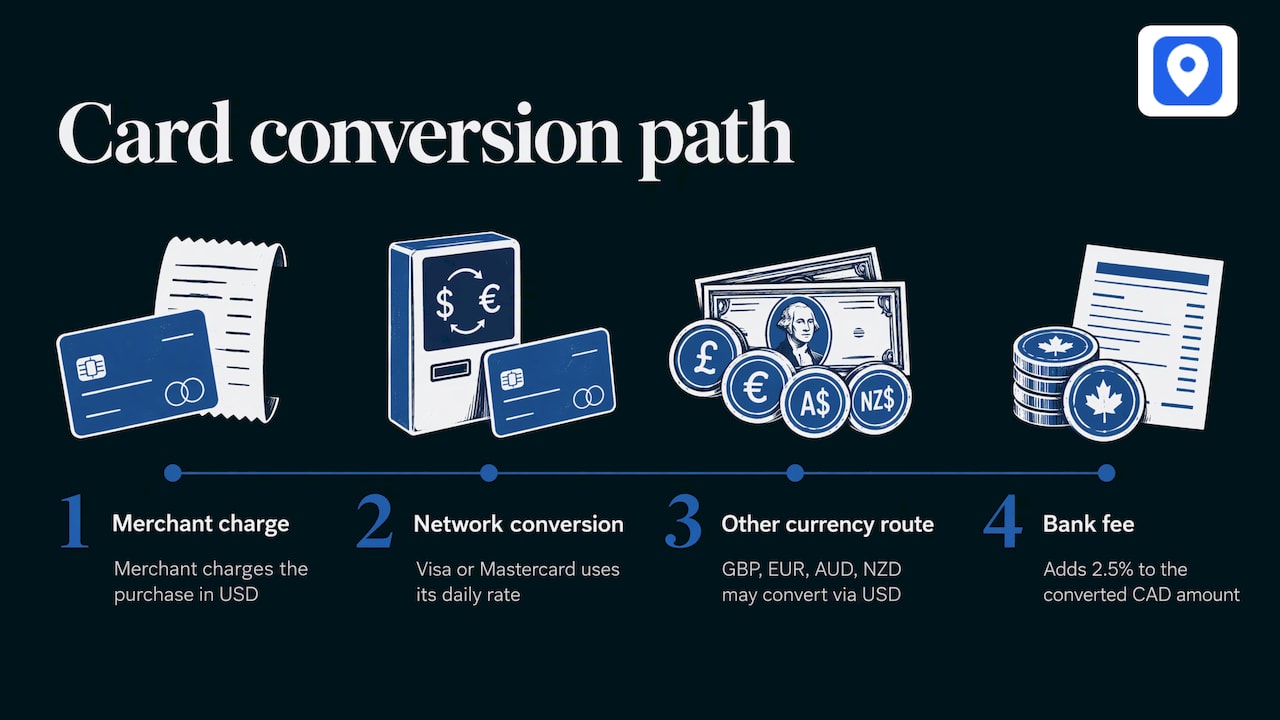
The network rate and the bank fee are separate costs. The network rate is close to wholesale. The fee is where most of the cost sits.
Which rate applies, and when
The rate is not the one you saw when you paid. It is generally the rate when the transaction posts to your account, which can be a day or more later. Mastercard Canada’s converter page says its displayed rate is indicative, may include a bank fee you enter, and can depend on authorization or processing timing. The amount on your statement is the only final number.
American Express works differently on paper. Amex Canada’s FAQ does not publish one universal rate or fee and sends cardholders to their Cardmember Agreement. The same logic applies to every issuer: your agreement, not a general rule, sets your price.
What the banks charge: the 2.5% fee and its exceptions
The published fee for standard Canadian cards is clustered tightly. Here is what the issuers’ own pages say:
| Issuer type | What the page says | Where it applies |
|---|---|---|
| Bank with Mastercard cards | Daily Mastercard rate plus 2.5% | Foreign purchases and withdrawals |
| Bank with Visa cards | Network rate when the transaction posts, then 2.5% | Some currencies route through USD |
| Bank fee schedule (effective February 1, 2026) | 2.5% on the converted amount for most cards | Four named cards are exempt |
| Bank rate-advantage Visa | CAD amount is 2.5% over the benchmark rate | Disclosure dated July 2022; benchmark generally set daily |
| Bank guidance for foreign-currency cards | Conversion fee set in the card’s disclosure statement | Rate in effect when the transaction posts |
The fee schedule in the table names Passport Visa Infinite+, Passport Visa Infinite Privilege, Gold American Express and Platinum American Express as exceptions with no such fee. Two cards from the same bank can therefore price the same purchase differently. If you travel often or pay US suppliers on a card, a no-foreign-transaction-fee card changes the maths. Check the annual fee and the card’s eligibility terms against the savings.
Exchange rate markup: the number that hides inside the fee
A markup is the gap between the mid-market rate and the rate you were given. The FCAC defines it as the difference between the mid-market rate (the midpoint between wholesale buy and sell rates) and the rate applied to your transaction. In its 2026 review, it reports markups typically between about 1% and 4%, depending on the bank, the currencies, and market conditions.
That range explains why a flat “2.5%” and a “markup” are the same thing viewed from two angles. On a card, the fee is your markup, added to a network rate that is already close to mid-market. For a bank’s cash exchange or wire, the markup is usually built into the rate with no separate line item, which is why it is harder to see.
How to calculate what a purchase really cost you
Use the Bank of Canada’s daily rate as your yardstick. The Bank says its published rates are indicative, based on averages of aggregated quotes from financial institutions, with daily averages published by 16:30 Eastern on business days. It is a fair benchmark, not a rate anyone is obliged to give you.
-
Find the foreign amount on your receipt or statement, for example US$500.00.
-
Look up the Bank of Canada rate for the posting date using the lookup tool, and multiply. At an illustrative 1.4000, US$500 is C$700.00.
-
Read the CAD amount actually billed on your statement—for example, C$717.50.
-
Subtract. C$717.50 minus C$700.00 is C$17.50.
-
Divide by the benchmark amount. C$17.50 divided by C$700.00 is 2.5%.
-
Work out your effective rate. C$717.50 divided by US$500 is 1.4350 per US dollar, against 1.4000 at the benchmark.
The 1.4000 figure is only a round number for the worked example. Use the real rate for your date. Because the card network and the Bank of Canada use different timing and sources, expect small differences even before the fee. If your result is much more than the stated fee, check whether the merchant converted the amount (see below).
Our free currency calculators are built for this comparison, and each comparison on our site shows the date it was checked.
A worked example from the FCAC
The FCAC’s 2026 illustration uses US$1,000 and a Big Six bank rate of C$1.4607 per US$1. That costs C$1,460.70 with no transfer fee, and the FCAC estimates the markup at C$39.70. After removing the markup, the mid-market cost is C$1,421.00, so C$39.70 is about 2.8% of it. That sits inside the 1% to 4% range above, and it is close to a card’s 2.5% fee. The FCAC example is a transfer, not a card purchase, but it shows how the same percentage turns into dollars.
Pay in Canadian dollars or the local currency?
A card terminal or website abroad may offer to charge you in Canadian dollars. This is dynamic currency conversion, and the merchant or ATM operator does the converting. Mastercard states that when a merchant or ATM operator converts, its conversion rates do not apply. Your bank’s fee may still apply on top, depending on your card.
The safe default is to choose the local currency, USD for a US purchase, and let your card issuer convert. Our guide to dynamic currency conversion for Canadians shows how to spot the offer and what it tends to cost. The same applies at airport kiosks, where the markup is often wider: see airport currency exchange rates in Canada.
Refunds and timing
A refund is converted on its own date. CIBC’s guidance explains that the final posted amount and a later refund can use different daily rates, and that the conversion fee may apply to both. If you return a US$200 item, you may get back fewer Canadian dollars than you paid, even though the foreign amount is identical. For big-ticket purchases with a possible return, factor that in.
Cards versus transfers for larger amounts
A card is convenient for a hotel or a day of shopping. For thousands of dollars, the card fee scales with the amount: 2.5% of C$10,000 is C$250, and many issuers also restrict how much you can charge or treat large payments as cash-like transactions. Check your agreement for these terms.
The better test for larger amounts is the total cost: how many Canadian dollars left your account and how many US dollars arrived. The FCAC’s 2026 review compares two ways of sending US$1,000. The Big Six bank rate implied a C$39.70 markup per transfer, while a fintech tracking the mid-market rate charged a C$9.46 transfer fee. Repeated monthly, that is C$476.40 a year against C$113.52. The FCAC presents this as an example, not a quote you are guaranteed, so compare real quotes on the day.
The amounts that matter most to our readers are these:
-
Snowbirds moving money south for the winter, often in repeated, large transfers where a percentage difference compounds.
-
Buyers and sellers of US property, where a deposit or closing payment is a single large conversion. Our USD to CAD and CAD to USD rate pages show the published rates and the date they were checked, and our selling US dollars guide covers the other direction.
-
Students paying US tuition, where a card may be capped or may carry the same 2.5% charge on each installment.
-
Cross-border workers paid in USD, who convert regularly and may be better served by holding USD. Read about USD chequing accounts in Canada and multi-currency accounts for what they cost.
Wire transfers have their own cost layers, including fees charged by intermediary banks along the route. See intermediary bank fees on USD transfers and our guide to a wire transfer from Canada to the USA for the steps and costs.
A practical checklist before you pay in USD
-
Open your cardholder agreement and find the foreign-currency conversion fee for your exact card.
-
Choose to pay in the local currency, not Canadian dollars, when a terminal asks.
-
Keep the receipt, then compare your posted CAD amount with the Bank of Canada rate for the posting date.
-
For recurring or large USD payments, get a quote showing the CAD you pay and the USD received, including all fees.
-
Remember that GBP, EUR, AUD and NZD purchases may be routed through US dollars on some cards, which can add to the cost.
Compare providers against the Bank of Canada rate
We built Currency Exchange Near Me to make this comparison simple. Every listing is independently researched, with no providers paying for placement or ranking. We compare banks, online money transfer services, and local exchange providers against the Bank of Canada rate, verify each provider in the FINTRAC registry, and score them by BBB rating, published rates, and customer reviews.

If you are sending Canadian dollars south, start with the Canadian currency exchange comparison to see the cost of each option before you move money, or read how to send money from Canada to the USA by Interac e-Transfer alternatives. Moving funds the other way? See how to transfer money from the USA to Canada.
FAQ
What exchange rate does a credit card use in Canada?
The card network converts the purchase at its own daily rate, usually the one in effect when the transaction posts. Your bank then adds its conversion fee, which several Canadian banks list at 2.5%. The amount on your statement is the final cost.
What is the Mastercard or American Express exchange rate in Canada?
Mastercard’s converter shows an indicative rate that can shift with authorization or processing timing, so it is an estimate rather than your final billed amount. American Express Canada directs cardholders to their Cardmember Agreement for the rate and fee details that apply to their card.
How much do banks charge for currency exchange?
On cards, published fees are commonly 2.5% of the converted amount. On cash exchanges and transfers, the charge is a markup built into the rate. The FCAC reports markups typically between about 1% and 4% above the mid-market rate, so compare the rate you are given with the Bank of Canada rate.
Can I avoid credit card foreign transaction fees?
Some cards waive the fee. One major bank’s fee schedule, for example, names four cards that carry no foreign-currency conversion fee. The waiver is card-specific, so check your own agreement. For large amounts, compare the total cost of a transfer instead.